
Freezer Not Freezing? Protect the Food First, Then Look for Evidence
When a freezer stops freezing, the priority is frozen food, not a parts list. A freezer not freezing can mean the compartment is completely warm, partially thawed, holding at an unsafe temperature or simply not reaching the target. Each pattern points to different systems and different urgency. Before buying a part or scheduling a visit, find out what the freezer is actually doing and whether the refrigerator section is affected too.
The FDA recommends keeping a freezer at 0°F or below. A full freezer holds its temperature for about 48 hours during an outage if the door stays closed. A half-full freezer holds for about 24 hours. These are general guidelines based on USDA and FoodSafety.gov outage guidance; actual hold time depends on the food density, room temperature and how often the door has been opened. If frozen food has thawed above 40°F and stayed there for more than two hours, FoodSafety.gov advises discarding it.
For help arranging freezer diagnosis in Staten Island, tell us the brand, model number, measured temperatures and whether the refrigerator section is still cooling. Appointment availability, the business handling the visit, diagnostic terms and repair scope should be confirmed before the appointment.
Request Freezer Service
What Should You Do in the First 15 Minutes?
Use this order. It protects frozen food and gives a service professional better evidence without creating a safety hazard or destroying diagnostic clues.
- Keep the freezer door closed. Every unnecessary opening raises the temperature and shortens the safe hold time. Do not stand with the door open checking individual items.
- Measure the temperature. Use an appliance thermometer placed in the freezer. Record the time and temperature. A display setting is not the same as a measured compartment temperature.
- Check the refrigerator section. If the fresh-food compartment is also warm, the problem may affect the entire cooling system rather than the freezer alone. If only the freezer is warm while the refrigerator is cold, the fault may be more specific.
- Check for a power problem. Verify that the refrigerator lights work and other appliances in the kitchen have power. If there is a borough outage, report it to Con Edison and wait for restoration before concluding the appliance has failed.
- Review the controls. Check whether the freezer has been set to a warmer position, placed in a demo or showroom mode, or changed after a cleaning or a child’s contact. Consult the owner manual because control layouts and names differ by model.
- Listen carefully. Note whether the compressor hums, fans run, you hear clicking, scraping, buzzing or silence. Record whether any sounds are new or intermittent.
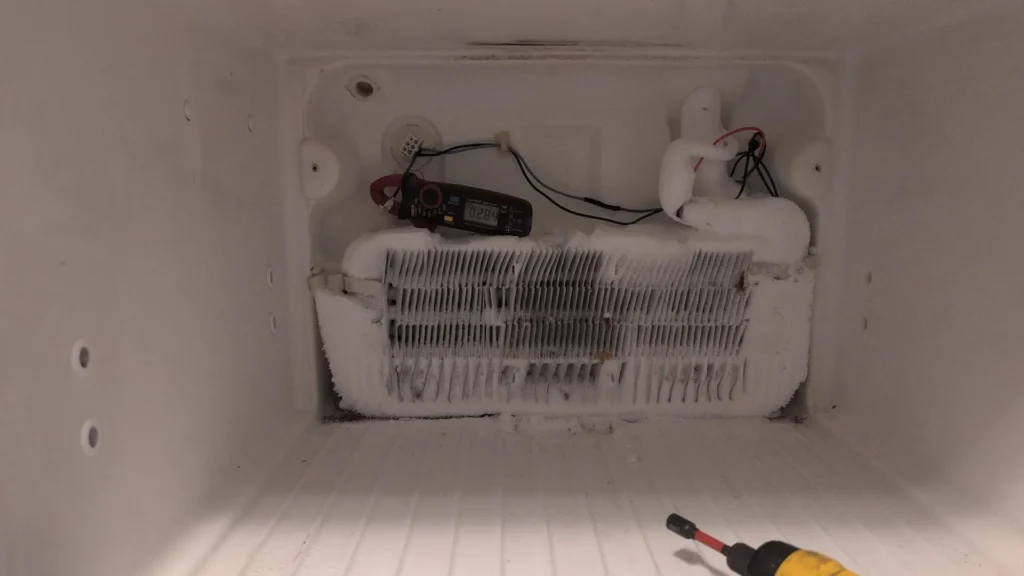
- Look at frost and ice patterns. Heavy frost on the back wall, ice around a drain area, or frost-free surfaces where frost once existed can narrow the diagnostic path.
Stop and change course if there is smoke, sparking, a burning odor, a hot or damaged plug, repeated breaker trips, flood exposure or water reaching an electrical connection. Do not touch a wet appliance while standing in water.
Freezer Not Freezing: Match the Pattern Before Naming the Part
“Not freezing” describes several distinct conditions. The pattern helps define which systems need evaluation, but no single observation confirms a failed component.
| What you observe | Safe information to collect | Systems that may need evaluation |
|---|---|---|
| Freezer warm, refrigerator still cold | Temperatures in both sections, fan sounds, frost pattern, door seal | Evaporator fan, airflow path, damper, defrost system, sensor, control |
| Both freezer and refrigerator warm | Power status, display mode, sounds, recent outage, room temperature | Power supply, controls, fans, start components, compressor, sealed system |
| Freezer holds at 15–25°F but not 0°F | Actual temperature over time, loading, door-open frequency, room heat | Airflow restriction, gasket, defrost timing, sensor, overload, ambient conditions |
| Food soft in some areas but frozen in others | Location of soft items, vent positions, door-seal contact | Airflow distribution, fan, blocked vent, gasket problem in one zone |
| Heavy frost covering the back wall or vents | Frost extent, defrost-cycle sounds, gasket condition | Defrost heater, sensor, thermostat, timer, control, drain, door seal |
| Frost-free surfaces where frost should exist | When defrost last ran, temperature history, defrost sounds | Defrost system running excessively, sensor, control, ambient temperature |
| Repeated clicking then silence | Click interval, temperature at the time, prior outage or surge | Start relay, overload, compressor, control, power-quality condition |
Why is the freezer not freezing while the refrigerator works?
In many refrigerator-freezer designs, the evaporator is located in the freezer section and cold air is shared with the fresh-food compartment through ducts and fans. If the refrigerator stays cold while the freezer warms, the problem may involve a failed evaporator fan, blocked airflow, a stuck damper, an iced evaporator, a defrost-system fault, a sensor or a control. Some dual-evaporator models have independent cooling circuits, which changes the diagnostic path entirely. The model number determines which design applies.
Why is the freezer running but not cold enough?
A freezer that maintains 15°F or 20°F instead of 0°F may not have a dramatic part failure. Possible contributing factors include a worn door gasket allowing warm air, overpacking that restricts airflow, frequent door openings, a warm kitchen, a failing sensor, an undersized unit for the environment or a defrost cycle that runs too long. However, a gradual loss of cooling efficiency can also indicate a sealed-system problem developing over time.
Record the actual measured temperature, the room temperature, loading habits and the door-seal condition before calling. That information helps a technician prioritize testing.
What does heavy frost buildup mean?
Frost covering the back wall, evaporator cover or vent area in a frost-free freezer usually means the automatic defrost system is not working correctly. The defrost heater, defrost sensor or thermostat, timer or control board, or drain may be at fault. Less commonly, a gasket leak allows humid air to enter and freeze repeatedly.
Heavy frost restricts airflow and makes the freezer work harder without cooling properly. Do not chip or scrape built-up frost with a knife, screwdriver or sharp tool. You can damage the evaporator, the liner or a sensor. Follow the manufacturer’s manual defrost procedure if one exists for the model.
Standalone Freezer Versus Freezer Compartment
The symptoms and triage are similar, but standalone chest freezers and upright freezers have some differences from a built-in freezer compartment within a refrigerator.
Chest freezer
A chest freezer has its own compressor, condenser and evaporator. When it stops freezing, common areas to evaluate include the thermostat, start components, compressor, condenser fan or coil, door gasket and the power supply. Because the lid opens from the top, cold air is retained better when the lid is opened. A full chest freezer can hold safe temperatures longer than a partially filled upright.
Upright freezer
An upright standalone freezer functions similarly to a chest model but loses cold air faster when the door is opened because cold air falls out. Frost-free upright models have an automatic defrost system; manual-defrost models do not. Check the model type before assuming a defrost component is involved.
Freezer section of a refrigerator-freezer
This is the most common configuration in Staten Island households. The freezer and refrigerator share a cabinet, a power supply and often a single sealed refrigeration circuit. Problems in one section can affect the other. Always report both the freezer and refrigerator temperatures when requesting service.
Safe Checks You Can Make Without Disassembling Anything
Confirm the setting and mode
Check whether the freezer control is at the correct setting. Some models use a numbered scale where a higher number means colder; others display an actual temperature. Look for demo mode, showroom mode, Sabbath mode or cooling-off mode. Refer to the owner manual for the exact model because button sequences and labels vary.
Check the door seal
Run your hand along the gasket to feel for gaps, tears, compression or areas where the seal does not make contact. Look for food debris, spills or warped gasket material. If the door does not close firmly on its own or pops open easily, the gasket, hinge or door alignment may need attention. Photograph any gap or damage.
Check visible vents and loading
Overpacked shelves and items pressed against vents or the rear wall can block cold-air circulation. Leave space around interior vents and avoid covering the evaporator cover plate. A freezer that is too empty may also lose temperature faster when the door opens.
Listen to the appliance
When the door is closed, listen for compressor operation, fan sounds, clicking, buzzing or complete silence. If the compressor runs but no fan sound accompanies it, the evaporator or condenser fan may have stopped. If you hear repeated clicking followed by silence, the start circuit or compressor may be involved.
Check whether the floor is wet or frost is visible outside
Water or frost appearing on the outside of the freezer door, on the floor nearby or around the gasket area may indicate a seal failure that allows humid air to enter. Outside condensation alone does not mean the sealed system is leaking, but persistent moisture may worsen internal frost and reduce cooling performance.
What Usually Requires Professional Diagnosis?
If the safe checks do not restore proper freezing, the following systems typically require on-site testing.
Evaporator and airflow system
The evaporator absorbs heat from inside the freezer. If it is iced over, the fan has failed, a duct is blocked or the defrost system is not clearing frost, the freezer cannot maintain 0°F. Accessing the evaporator usually requires removing an interior panel, which is a service-level task.
Automatic defrost system
In frost-free models, the defrost heater, defrost thermostat or sensor, and defrost control or timer work together to periodically melt frost from the evaporator. A failed component in this circuit allows frost to accumulate until it blocks airflow. Diagnosing which component failed requires testing, not just observing frost.
Compressor and sealed refrigeration system
If the compressor does not start, runs but does not cool, or cycles abnormally, the sealed system may need evaluation. Start components, controls, fans and electrical conditions can produce similar symptoms. Sealed-system work—including pressure testing, leak detection, refrigerant recovery and recharging—requires appropriate equipment and personnel who meet EPA Section 608 certification requirements. This is not a homeowner task.
Temperature sensors and control board
Modern freezers use thermistors and electronic control boards to regulate temperature and defrost timing. A faulty sensor can report incorrect temperatures, causing the compressor to run too little, too long or not at all. Error codes are model-specific and should be photographed before clearing.
Door, gasket and hinge
A worn gasket, loose hinge, misaligned door or damaged seal allows warm, humid air to enter. The freezer compensates by running longer, frost accumulates, airflow decreases and the temperature rises. Gasket replacement requires the correct model-specific part and proper installation to restore seal integrity.
Frozen Food Safety When the Freezer Fails
Appliance repair decisions and food-safety decisions are different. Protect people first.
- A full freezer holds safe temperatures for approximately 48 hours during an outage if the door stays closed. A half-full freezer holds for approximately 24 hours.
- Frozen food that has thawed and warmed above 40°F for more than two hours should be discarded, according to FoodSafety.gov.
- Frozen food that still contains ice crystals or is at 40°F or below may be refrozen or cooked, per FDA guidance.
- Do not refreeze food that has been above 40°F for an extended period, even if it still looks normal. Bacteria can grow without visible signs.
- Never taste food to decide whether it is safe.
- Group frozen items together to help them retain cold. Fill empty freezer space with containers of water, frozen gel packs or crumpled newspaper.
Use the official FoodSafety.gov outage chart for item-by-item decisions.
Staten Island Conditions That Affect Freezer Problems
Summer heat and freezer workload
When outdoor temperatures climb above 90°F and indoor humidity rises, freezers work harder to maintain 0°F. A unit in a hot garage, un-air-conditioned basement or enclosed porch may struggle more than one in a climate-controlled kitchen. Most manufacturers specify an ambient operating range in the installation guide. Exceeding it does not break the freezer, but it increases run time, energy use and the stress on the sealed system.
Power outages and storm events
Coastal storms, heavy rain, high winds and utility disruptions can cause power loss across Staten Island. Report outages to Con Edison and follow their restoration timeline. Do not repeatedly cycle the breaker or unplug and reconnect the freezer. After power returns, give the unit the model-specified recovery time before evaluating performance.
Flood exposure
Do not energize a freezer that was submerged or reached by floodwater. Flooded electrical equipment can create shock, short-circuit and fire hazards even after the water recedes. Arrange evaluation by the appropriate qualified professional and notify the insurer, property owner or building manager as relevant.
Apartment and building access
If the freezer is a standalone unit in a basement storage area, a building utility room or a tight apartment kitchen, access constraints affect scheduling. Tell the scheduler about elevator restrictions, narrow doorways, floor-protection requirements, building hours and certificates of insurance. Determine who owns the appliance and who is responsible for service under the lease or building rules before authorizing work.
What to Record Before Requesting Service
Good information shortens the path from “not freezing” to a testable problem.
- Full brand and model number from the appliance label.
- Measured freezer temperature and refrigerator temperature, with the time.
- Whether the problem is in a standalone freezer or the freezer section of a combination unit.
- When the problem started and whether it is constant or intermittent.
- Fan, hum, click, scrape or silence patterns.
- Location and extent of frost, ice or water.
- Any display message or error code, photographed before reset.
- Recent outage, surge, defrost event, move, cleaning or door-left-open event.
- Ambient conditions: location of the freezer, room temperature and ventilation.
- Warranty, service-contract or recall status.
- Access limits, ownership and building requirements.
Search the exact model at the CPSC recall database and the manufacturer’s support site for known freezer issues.
When Should You Stop Checking and Request Diagnosis?
A freezer not freezing after confirming the power supply, control setting, door seal and basic loading conditions needs professional diagnosis. Request service promptly when:
- The freezer temperature continues to rise after the safe checks.
- Both the freezer and refrigerator sections are warm.
- Heavy frost has built up on the evaporator or rear wall and returns after clearing.
- The compressor clicks repeatedly and then goes silent.
- You hear abnormal sounds, smell something burning or see sparking.
- The freezer was exposed to floodwater, a surge or repeated breaker trips.
- Frozen food has partially thawed and you need to decide quickly about the appliance.
When arranging service, ask:
- Who will handle the appointment and diagnosis?
- What does the diagnostic or service-call fee cover?
- Does the fee apply to the freezer alone or to both sections of a combination unit?
- Is the written option itemized for parts, labor, tax and other charges?
- Is sealed-system work included if testing points there?
- Is a return visit expected if a model-specific part is required?
- What repair and warranty terms will be provided in writing?
Request Freezer Diagnosis
Repair or Replace a Freezer That Is Not Freezing?
The decision depends on the failed system, not just the symptom. A defrost sensor, an evaporator fan or a start relay presents a different cost picture from compressor failure or a sealed-system leak. Standalone chest freezers are generally less expensive to replace than built-in or combination units, which affects the repair-versus-replace math.
Consider the quoted repair cost, part availability, appliance age and condition, repeat-failure history, replacement cost including delivery, food-loss exposure and whether the freezer is standalone or part of a refrigerator that is otherwise working well.
Compare both paths → /resources/repair-or-replace-appliance/ Understand quote components → /resources/appliance-repair-cost-staten-island/
Get Help With a Freezer Not Freezing in Staten Island
If you have checked the power, controls, door seal and loading, and the freezer still is not reaching 0°F, request a model-aware diagnosis. Describe what both sections are doing, what you hear, where frost appears and whether the problem followed a power event. Confirm appointment availability, diagnostic terms, provider scope and written authorization before work begins.
Phone hours: 8:00 a.m. to 5:00 p.m. daily.
Refrigerator and freezer service overview → /services/refrigerator-freezer-repair/ Cooling problems → /resources/refrigerator-not-cooling/ Leak problems → /resources/refrigerator-leaking/ How the visit works → /how-it-works/ Service-area review → /service-areas/