
Washer Not Spinning? Check the Load Before Blaming the Motor
A washer not spinning leaves clothes soaking wet and heavy, extends drying time, and may mean there is still water trapped in the drum. Before you assume a motor or control board has failed, check whether the problem is the load, the lid or door, a safety interlock or a detectable error code. Many spinning failures have a cause that is visible or audible without disassembling the machine.
Spinning is the fastest and most forceful phase of the wash cycle. It generates centrifugal force to extract water from clothes, which is why washers are designed with multiple safety systems to prevent spin when a load is unbalanced, the lid or door is open, or a sensor detects a potential hazard. A washer that intentionally stops spinning is doing its job. A washer that fails to reach spin speed, shakes violently, stalls mid-cycle or never attempts to spin points to a different set of causes.
For help arranging washer diagnosis in Staten Island, tell us the brand, model number, front-load or top-load, and exactly what happens when the washer should spin. Appointment availability, the business handling the visit, diagnostic terms and repair scope should be confirmed before the appointment.
Request Washer Service
What Should You Do When the Washer Will Not Spin?
Use this order. It addresses the most common owner-level causes first and avoids creating a safety problem.
- Cancel the cycle. Press pause or cancel. Wait for the door or lid lock to release. If the lock does not release, wait two minutes and try again. Do not force the door on a front-load washer.
- Check the load size and distribution. An unbalanced or overly heavy load is the most common reason a washer stops spinning. Bulky items such as comforters, rugs, towels and pillows can shift to one side and trigger the unbalance sensor. Redistribute the load evenly around the drum and restart.
- Check for a single heavy item. One wet bath mat, rug or heavy jacket paired with lightweight items can create an unbalanced mass that the washer cannot compensate for. Wash heavy items with similar-weight items.
- Check the lid or door. Top-load washers will not spin if the lid is open or the lid switch has failed. Front-load washers will not spin if the door lock is not engaged. Look for an obstruction in the lid switch or door latch, fabric caught in the seal, or an error light indicating a lock fault.
- Look for an error code. Record any display code or flashing pattern. Error codes related to unbalance, lid switch, door lock, motor, drive, drain or speed sensor are model-specific. Photograph the code before clearing.
- Confirm the washer drained. Most washers will not advance to spin if the drum still holds water. A washer not spinning may actually be a washer not draining first. Check for standing water and refer to drainage troubleshooting if water remains.
- Check the floor and leveling. A washer that is not level on the floor can vibrate excessively and trip the unbalance sensor during spin. Rock the washer gently by pushing on opposite corners. If it moves, the leveling legs or the floor surface may need attention.
Stop and change course if the washer shakes violently, walks across the floor, makes a loud banging or grinding noise, smells hot, sparks or trips the breaker. These are stop-use conditions, not adjustment opportunities.
Washer Not Spinning: Match the Pattern Before Buying a Part
“Not spinning” describes several different conditions. Each pattern points to different systems.
| What you observe | Safe information to collect | Systems that may need evaluation |
|---|---|---|
| Washer will not attempt to spin at all | Error code, lid/door lock status, whether drain completed, sounds | Lid switch, door lock, control board, motor relay, wiring |
| Washer starts to spin then stops | Load distribution, speed reached, vibration level, error code | Unbalance sensor, suspension, shock absorbers, load size |
| Washer spins slowly but not at full speed | Speed during spin, load size, noise, recent change | Motor, motor control board, speed sensor, belt, clutch |
| Washer makes loud noise during spin | Type of noise (banging, scraping, grinding, squealing), vibration | Drum bearing, spider arm, foreign object, shock absorbers, suspension |
| Washer shakes violently during spin | Floor condition, load type, leveling, transit bolts | Leveling legs, uneven floor, transit bolts not removed, suspension |
| Washer agitates but will not spin | Agitation speed, spin silence, coupling or clutch sounds | Motor coupling, clutch, shift actuator, drive belt, transmission |
| Clothes still soaking wet after spin | Spin speed, cycle selected, load type, drain completion | Spin speed setting, drain issue, low spin cycle selected, pump |
Why does the washer stop mid-spin?
The most common cause is an unbalanced load. Modern washers monitor vibration during spin acceleration and will slow down or stop if the drum exceeds a safe vibration level. This protects the machine and the floor. Redistributing the load and restarting usually resolves it. If the washer stops mid-spin repeatedly with different loads, the suspension system, shock absorbers, springs or dampers may be worn.
Why does the washer agitate but not spin?
On direct-drive top-load washers, agitation and spin use different mechanical paths. A failed motor coupling—a rubber and plastic connector between the motor and transmission—can transmit enough force to agitate but not enough to spin. A worn clutch, failed shift actuator or transmission problem can produce the same symptom. On belt-driven models, a broken or slipping belt prevents spin while the motor may still run.
Why are clothes still wet after the spin cycle?
Several explanations are possible without a component failure. A low-spin or delicate cycle extracts less water by design. A heavy load may not spin at full speed. If the washer did not drain completely before spinning, clothes will remain wet regardless of spin speed. Check the selected cycle, drain completion and whether the drain filter is clear. If the spin speed is genuinely reduced despite selecting a high-spin cycle, the motor, speed sensor, control board or drive system may need evaluation.
Load, Leveling and Installation: The Owner-Level Fixes
Before scheduling service, address the three most common non-mechanical causes of a washer not spinning.
Load management
- Do not overload the drum. Follow the manufacturer’s capacity guidelines. A drum packed tightly does not allow clothes to redistribute during spin.
- Wash bulky items in matched pairs when possible: two towels rather than one towel and several small items.
- Do not wrap sheets or large items around the agitator or in a tight ball.
- On front-load washers, distribute items evenly. A single heavy item on one side of the drum creates an unbalance that the counterweight system cannot correct.
Leveling
All four feet must make firm contact with the floor. Use a level across the top of the washer in both directions. Adjust the leveling legs until the washer is stable and does not rock. On some models, the rear legs are self-adjusting: tilt the washer forward slightly and let it settle back.
A washer on a weak floor, a plywood subfloor over joists, or an uneven surface may vibrate excessively regardless of leveling. Anti-vibration pads can reduce noise but do not correct structural floor problems.
Transit bolts and shipping brackets
New washers ship with transit bolts, brackets or shipping rods that lock the drum during transport. If these are not removed during installation, the drum cannot move freely, the washer shakes violently during spin and the suspension system can be damaged. Check the installation guide if the washer was recently installed, moved or delivered.
What Usually Requires Professional Diagnosis?
If the load, leveling, transit bolts, door or lid lock and drain have all been checked and the washer still will not spin, the following systems typically require on-site testing.
Motor and drive system
The motor rotates the drum through a direct drive, belt, coupling or transmission. Motor failures, worn brushes on older models, control-board faults, loose wiring and drive-component wear can reduce or eliminate spin. Intermittent motor problems may appear only under the higher torque demand of the spin cycle.
Motor coupling (direct-drive top-load washers)
On many Whirlpool and Kenmore direct-drive designs, a rubber and plastic coupling connects the motor to the transmission. When it breaks, the washer may agitate weakly or not at all and will not spin. The coupling is an internal component and requires accessing the underside of the washer.
Clutch and shift actuator
The clutch engages the spin basket and allows it to accelerate. A worn clutch can produce burning odor, slow spin or no spin. The shift actuator on newer models mechanically transitions the washer between agitation and spin. A failed actuator prevents the transition.
Shock absorbers, dampers and suspension springs
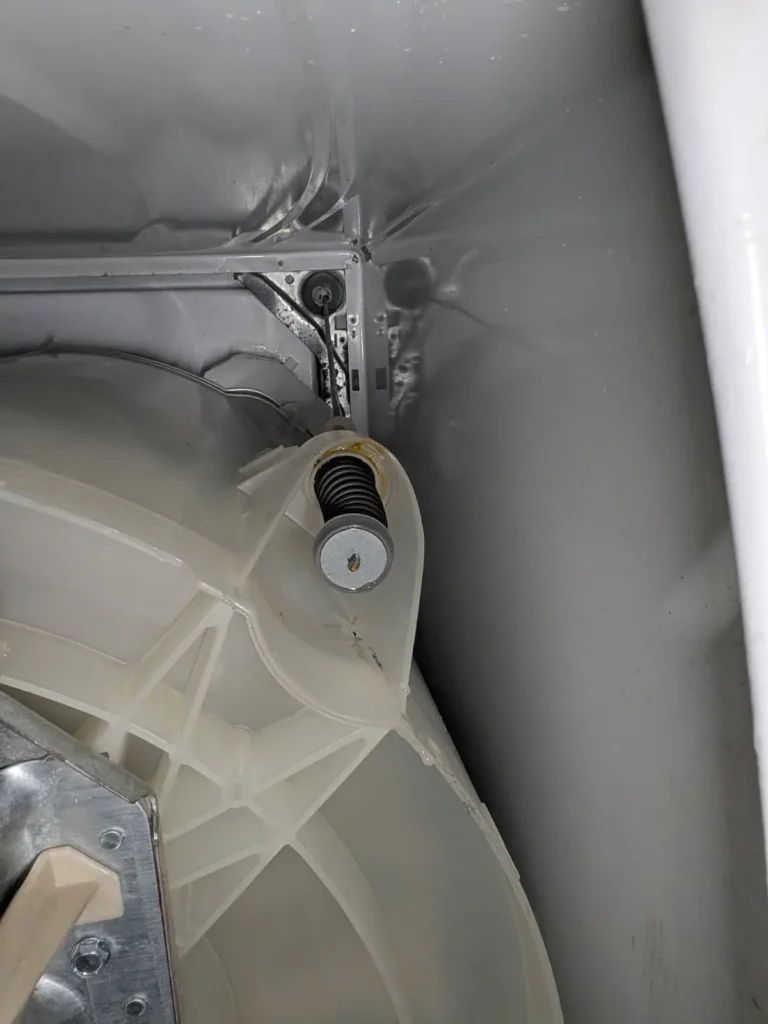
Front-load washers use shock absorbers or dampers to control drum movement. Top-load washers use suspension springs and damper pads. Worn components allow excessive movement, triggering the unbalance sensor even with a normal load. A washer that repeatedly stops during spin with different, properly distributed loads may need suspension work.
Drum bearing and spider arm
The main drum bearing allows the inner tub to rotate freely. A bearing that has failed or is failing can produce a roaring, grinding or rumbling noise during spin, and the drum may feel rough when rotated by hand. On front-load washers, the spider arm connects the inner drum to the bearing shaft. A corroded or cracked spider arm is a structural failure that can make the drum wobble and the washer unable to spin safely.
Bearing and spider-arm repairs are labor-intensive. The repair cost compared to the appliance’s age and replacement cost is a significant factor.
Speed sensor
The speed sensor—also called a tachometer or Hall sensor—reports the drum speed to the control board. If it sends an incorrect signal, the control board may not allow the motor to reach full spin speed or may abort the spin cycle. Speed-sensor problems can produce error codes related to motor speed or spin faults.
Lid switch and door lock assembly
A faulty lid switch on a top-load washer tells the control board the lid is open, even when it is closed. The washer will not spin. Similarly, a failed door lock on a front-load washer prevents the spin cycle. Both components are safety devices and should be replaced with the correct model-specific part.
Staten Island Conditions That Affect Spin Problems
Apartment floors and vibration
Many Staten Island apartments have wood-frame floors that flex during high-speed spin cycles. A washer that worked quietly in a ground-level laundry room may vibrate noticeably on an upper floor. Anti-vibration pads may reduce noise transmission but do not fix structural flex. If neighbors report vibration or noise, the spin speed, washer location, load habits and floor condition should all be reviewed.
Stacked laundry units
Stacked washer-dryer combinations are common in compact Staten Island apartments and laundry closets. A stacked washer must be perfectly level, and the stacking kit must be properly installed. Spin vibration in a stacked unit can affect the dryer above and the stability of the entire assembly.
Laundry closets and tight spaces
A washer vibrating inside a narrow laundry closet can contact walls, shelving, plumbing or the dryer. The resulting noise and movement may seem like a mechanical failure when the real issue is inadequate clearance. Check the manufacturer’s minimum clearance requirements.
Landlord and tenant responsibility
If the landlord installed the washer, notify the landlord or property manager in writing about the spin problem. New York guidance says landlord-installed appliances in multiple dwellings must be maintained in good and safe working order. Spin-related vibration that damages walls, floors or shared surfaces may also be a building-management matter.
What to Record Before Requesting Service
- Full brand and model number from the appliance label.
- Front-load or top-load configuration.
- The exact symptom: no spin attempt, partial spin, loud noise during spin, violent shaking or clothes still wet.
- The error code, photographed before clearing.
- Whether the washer drains normally.
- Whether the problem happens with every load or only certain types.
- Whether the washer was recently installed, moved or delivered (transit bolts).
- The floor type and condition under the washer.
- Whether the washer is stacked or standalone.
- Warranty, service-contract or recall status.
- Access limits, ownership and building requirements.
Search the exact model at the CPSC recall database and the manufacturer’s support site.
When Should You Stop Checking and Request Diagnosis?
A washer not spinning after redistributing the load, checking the level, confirming the lid or door lock and verifying drainage needs professional diagnosis. Request service promptly when:
- The washer never attempts to spin with any load.
- The washer makes loud banging, grinding or scraping noises during spin.
- Violent shaking persists with balanced, small loads.
- An error code related to the motor, drive, speed or lock persists.
- The washer agitates but will not transition to spin.
- You smell burning during the spin cycle.
- There is water near the power cord, outlet or electrical connections.
When arranging service, ask:
- Who will handle the appointment and diagnosis?
- What does the diagnostic or service-call fee cover?
- Is the written option itemized for parts, labor, tax and other charges?
- Does the diagnosis include evaluating the bearing and suspension?
- Is a return visit expected if a model-specific part is required?
- What repair and warranty terms will be provided in writing?
- Will the technician test the washer with a controlled load, or only inspect components?
Request Spin Diagnosis
Spin Speed and Cycle Selection: What Is Normal?
Before concluding the washer is broken, check whether the selected cycle explains the result.
Delicate and hand-wash cycles
Delicate, gentle and hand-wash cycles use lower spin speeds by design to protect fabrics. Clothes will feel wetter after these cycles than after a normal or heavy-duty spin. This is expected behavior, not a malfunction.
Rinse-and-spin and drain-and-spin cycles
If the washer does not spin during a full wash cycle but works on a rinse-and-spin or drain-and-spin cycle, the problem may be in the wash-cycle logic, a sensor involved in the main cycle, or a load-balancing issue specific to the heavier water load during wash.
Eco and water-saving modes
Some models reduce spin speed or time during eco cycles to save energy. Check the cycle description in the owner manual to confirm expected spin performance before assuming a fault.
Repair or Replace a Washer That Will Not Spin?
The answer depends on the failed component. A lid switch, motor coupling or shift actuator is a different financial decision from a drum bearing, spider arm or transmission. Bearing and spider-arm repairs often approach or exceed half the replacement cost, especially on older front-load washers, which shifts the repair-versus-replace calculation.
Consider the quoted repair, part availability, appliance age, repeat history, replacement cost including delivery, haul-away, hookup, matching dryer considerations and whether the replacement fits the existing space and connections.
Compare both paths → /resources/repair-or-replace-appliance/ Understand quote components → /resources/appliance-repair-cost-staten-island/
Get Help With a Washer Not Spinning in Staten Island
If you have checked the load, leveling, door or lid, transit bolts and drain, and the washer still will not complete a spin cycle, request a model-aware diagnosis. Describe what the washer does when it should spin, what it sounds like and whether the problem is consistent. Confirm appointment availability, diagnostic terms, provider scope and written authorization before work begins.
Phone hours: 8:00 a.m. to 5:00 p.m. daily.
Washer service overview → /services/washer-repair/ Drain problems → /resources/washer-not-draining/ How the visit works → /how-it-works/ Service-area review → /service-areas/