
Dryer Not Heating? Check the Vent and the Power Before Assuming a Part Failed
A dryer not heating does not always mean a broken heating element or a bad gas valve. The drum may tumble, the motor may run and the timer may advance, but the clothes come out damp and cold. Before ordering a part or scheduling a visit, check whether the dryer has the right power, whether the exhaust vent is restricted and whether the cycle setting is correct. These three checks explain a large share of “no heat” complaints without disassembling anything.
The distinction between an electric dryer and a gas dryer matters immediately. An electric dryer heats with a resistance element powered by a 240-volt circuit. If one leg of that circuit fails—a tripped breaker, a blown fuse, a loose connection or a damaged cord—the dryer may run on the remaining 120 volts but will not produce heat. A gas dryer heats with a burner supplied by a gas line. If the gas supply is shut off, the pilot or igniter has failed, or the gas valve solenoids are worn, the dryer runs but stays cold. The safe checks and the safety risks are different for each.
For help arranging dryer heating diagnosis in Staten Island, tell us the brand, model number, whether the dryer is gas or electric, and what happens when you run a timed-heat cycle. Appointment availability, the business handling the visit, diagnostic terms and repair scope should be confirmed before the appointment.
Request Dryer Service
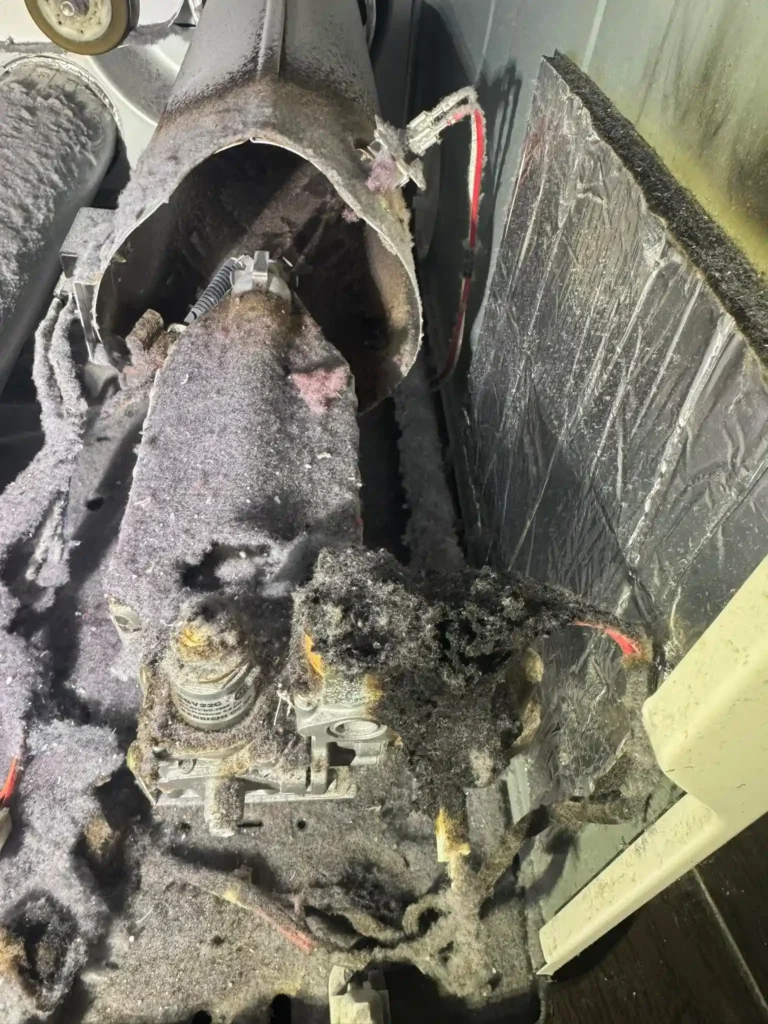
Safety First: Gas, Electrical and Ventilation Hazards
A dryer involves heat, electricity and potentially gas. Before checking anything, be aware of these stop conditions.
Stop immediately and get appropriate help if you detect:
- A gas odor near the dryer, in the laundry room or near the gas line. Do not flip a switch, light a match or use the phone near the odor. Leave the area and call the utility or 911 from a safe location. Con Edison’s gas emergency line is available 24 hours.
- Smoke, sparking, a burning odor, a hot or discolored plug, a scorched outlet or a damaged power cord.
- A tripped breaker that trips again when you reset it.
- Water near the power cord, outlet, gas connection or electrical panel.
- Visible lint accumulation around the gas burner area, vent opening or exhaust path.
These are not troubleshooting situations. They require professional evaluation before the dryer is operated again.
What Should You Check Before Calling?
Use this order. It addresses the most common explainable causes of a dryer not heating without requiring tools, disassembly or contact with internal components.
Check the power supply (electric dryers)
An electric dryer needs a dedicated 240-volt circuit. It typically connects to a two-pole breaker (two connected switches) in the electrical panel.
- Check both breaker positions. If one side trips while the other stays on, the dryer may run but not heat. Reset both sides at the same time if tripped. If the breaker trips again immediately, do not keep resetting it—call an electrician.
- Check the outlet. If the dryer plugs into an outlet, confirm the plug is fully seated. A loose plug or a damaged prong can reduce power.
- Check for a blown fuse. In older homes with a fuse panel, the dryer circuit may use two fuses. One blown fuse can allow the motor to run without the heating element.
Check the gas supply (gas dryers)
A gas dryer needs an active gas supply at the correct pressure.
- Check the gas shutoff valve. It is usually on the gas line behind or beside the dryer. The handle should be parallel to the pipe when open. If it is perpendicular, the gas is off.
- Check for a gas odor. If you smell gas, stop. Do not try to diagnose the dryer. Follow the gas-safety procedure above.
- Confirm gas service. If other gas appliances in the home are also not working, the building may have a gas service interruption.
Check the lint screen and exhaust vent
A restricted exhaust vent is a leading cause of poor dryer heating and is also a fire safety concern.
- Clean the lint screen. Remove it and clear all visible lint. If the screen feels greasy or residue remains, wash it with warm water and a brush. A coated screen restricts airflow even when it looks clear.
- Check the vent at the exterior wall. Go outside and confirm the exterior vent flap opens when the dryer runs. If it stays closed, barely moves or has visible lint, bird nests or debris, the vent path is restricted.
- Check the transition duct. Look at the duct between the dryer and the wall. A crushed, kinked, sagging or excessively long flexible duct restricts airflow. Foil or vinyl flex duct is not recommended by most manufacturers or fire-safety standards; rigid or semi-rigid metal is preferred.
- Feel the exhaust air. When the dryer runs on a timed-heat cycle, feel the air at the exterior vent. Weak airflow suggests a vent obstruction deeper in the line.
A restricted vent forces the dryer to work harder, reduces heating efficiency, extends dry time, causes the high-limit thermostat to trip, and increases fire risk. The U.S. Fire Administration and the CPSC identify dryer vents as a leading cause of home laundry fires, with failure to clean as the top contributing factor.
Check the cycle setting
Confirm the dryer is set to a heated cycle, not air-dry, fluff, no-heat or wrinkle-prevention. Some touch-panel dryers have settings that are easy to select accidentally. Check the owner manual for the correct cycle name and expected behavior.
Check the load
A single small item can dry quickly and feel cool when removed, appearing as though the dryer is not heating. Run a timed-heat cycle with a normal load of damp towels. If the drum feels warm and the towels are drying, the dryer may be working and the original problem was related to the load, cycle or vent.
Dryer Not Heating: Match the Pattern
The specific behavior narrows the diagnostic path. These observations help, but none confirms a failed part without testing.
| What you observe | Safe information to collect | Systems that may need evaluation |
|---|---|---|
| Electric dryer runs but no heat at all | Breaker status, both poles, outlet condition, cycle selected | 240V circuit, breaker, outlet, cord, terminal block, heating element |
| Gas dryer runs but no heat at all | Gas valve position, gas odor check, igniter glow, burner ignition | Gas supply, igniter, gas valve solenoids, flame sensor, control |
| Dryer heats briefly then stops heating | How long heat lasts, thermostat clicks, vent airflow, lint screen | High-limit thermostat, cycling thermostat, vent restriction, sensor |
| Dryer produces low heat, clothes still damp | Cycle setting, load size, vent airflow, exterior vent check | Vent restriction, element partial failure, gas-valve issue, thermostat |
| Dryer heats but takes much longer than normal | Time to dry a standard load, vent length, exterior airflow | Vent restriction, lint buildup, moisture sensor, cycling thermostat |
| Dryer shuts off mid-cycle | Time before shutoff, error code, heat level, motor sounds | Thermal fuse, high-limit thermostat, motor overload, control board |
| Burning smell from the dryer | Lint location, vent condition, new smell vs recurring | Lint in vent, lint near burner, belt friction, foreign object |
What is the thermal fuse, and why does it matter?
Most dryers have a thermal fuse—a one-time safety device that blows when the dryer exceeds a safe temperature, typically because of a vent restriction. Once a thermal fuse blows, the dryer will not heat (and on some models, will not run at all). The fuse is not designed to be reset; it must be replaced.
Replacing the thermal fuse without fixing the vent restriction that caused it to blow creates a fire hazard. The fuse blew for a reason. A proper repair addresses both the fuse and the root cause.
Why does the gas dryer igniter glow but the burner not light?
On many gas dryers, the igniter heats to a visible glow, then the gas valve solenoids open to release gas to the burner. If the igniter glows but the gas does not ignite, the solenoids may have failed. Worn solenoids are a common issue on aging gas dryers and can cause intermittent no-heat complaints where the dryer heats on some cycles but not others.
Why does the dryer heat at first but then stop?
This often points to a vent restriction causing the high-limit thermostat or cycling thermostat to trip. The dryer heats until the exhaust temperature rises too high, then the safety device shuts off the heat source. After cooling, the dryer may restart heating, then trip again—producing intermittent heat. Clean the lint screen, check the vent path and test the exterior airflow before assuming a component failure.
Vent Safety: The Connection Between Heating Problems and Fire Risk
Dryer vent maintenance is not just a performance issue. It is a safety issue.
- The U.S. Fire Administration reports that dryers cause an estimated 2,900 home fires per year, with failure to clean as the leading factor.
- The CPSC recommends cleaning the lint screen before or after every load and having the vent system inspected and cleaned regularly.
- A vent that exceeds the manufacturer’s maximum length, has too many elbows, uses non-rigid duct or terminates improperly reduces airflow and increases fire risk.
- Dryers should never be vented into a wall cavity, attic, crawl space or garage interior. The exhaust must terminate outdoors.
In Staten Island, multi-story homes, townhouses and attached dwellings often have long or routed vent paths through interior walls, soffits or rooflines. The longer and more complex the path, the more important regular cleaning becomes. A dryer vent cleaning service handles the full duct from the dryer to the exterior termination.
What Usually Requires Professional Diagnosis?
If the power supply, gas supply, lint screen, vent and cycle setting have all been checked and the dryer still does not heat, the following systems typically require on-site testing.
Heating element (electric dryers)
The heating element is a resistance coil that generates heat when current passes through it. A broken or open element produces no heat. Element failure is confirmed by electrical testing, not visual inspection alone, because a broken coil may not be obvious.
Gas valve solenoids and igniter (gas dryers)
The igniter, gas valve solenoids, flame sensor and burner assembly work together to ignite and maintain the gas flame. A failed igniter, worn solenoids or a faulty flame sensor can produce intermittent or total no-heat conditions. Gas dryer diagnosis should be performed by a technician experienced with gas appliances.
Thermal fuse and high-limit thermostat
The thermal fuse is a one-time safety device; the high-limit thermostat is resettable on some models. Both respond to excessive temperature. Testing them requires access to the dryer cabinet and electrical testing. Always address the root cause (vent restriction, failed component, lint buildup) when replacing a thermal safety device.
Cycling thermostat and moisture sensor
The cycling thermostat regulates operating temperature by switching the heat source on and off. A failed cycling thermostat can cause no heat, constant heat or erratic heat. The moisture sensor detects wet clothes and adjusts the cycle; contaminated or damaged sensors can end the cycle prematurely.
Timer, control board and wiring
The timer or electronic control determines when heat is applied during the cycle. A failed timer contact, a faulty control board or damaged wiring can prevent the heat circuit from closing. Intermittent wiring faults and corroded connections are particularly difficult to diagnose remotely.
Staten Island Conditions That Affect Dryer Heating
Long vent runs in multi-story homes
Many Staten Island homes route the dryer vent through interior walls, up through second-floor chases, into attic spaces or through roofline penetrations. Longer vent runs accumulate more lint, produce more back pressure and are harder to inspect. If the dryer has never heated well or performance has declined gradually, the vent path should be inspected before assuming a component failure.
Gas dryer safety and utility coordination
Gas dryers in Staten Island are served by National Grid or Con Edison depending on the location. If you smell gas, follow the utility’s gas emergency protocol. Do not attempt to diagnose a gas-related heating problem by testing the gas supply yourself. A technician experienced with gas appliances should handle gas valve, burner and igniter work.
Stacked and closet installations
Stacked dryers and dryers installed in tight closets may have restricted airflow around the cabinet, which affects cooling and can trigger thermal safety devices. Check the manufacturer’s minimum clearance requirements. A louvered or sealed closet door changes the airflow available to the dryer.
Apartment, condo and co-op considerations
If the landlord installed the dryer, notify the landlord or property manager in writing about the heating problem. New York guidance says landlord-installed appliances in multiple dwellings must be maintained in good and safe working order. Building rules about vent cleaning, gas-line access and electrical-panel access may also apply.
What to Record Before Requesting Service
- Full brand and model number from the appliance label.
- Gas or electric.
- What happens on a timed-heat cycle: no heat, brief heat, low heat, intermittent heat.
- Breaker status (electric) or gas-valve position (gas).
- Lint-screen condition and when the vent was last cleaned.
- Exterior vent airflow and flap movement.
- Error code, photographed before clearing.
- Whether the problem is new or has been worsening over time.
- Vent path: short and straight, long with elbows, through a wall or up to the roof.
- Whether the dryer is stacked or standalone.
- Warranty, service-contract or recall status.
- Access limits, ownership and building requirements.
Search the exact model at the CPSC recall database and the manufacturer’s support site.
When Should You Stop Checking and Request Diagnosis?
A dryer not heating after confirming the power supply, gas supply, lint screen, vent and cycle setting needs professional diagnosis. Request service promptly when:
- An electric dryer has full 240-volt power but produces no heat.
- A gas dryer has gas supply but the burner does not ignite.
- The thermal fuse has blown and the vent has not been inspected.
- The dryer heats intermittently and the vent appears clear.
- You smell burning, see discoloration at the outlet, or the breaker trips repeatedly.
- You smell gas near the dryer or gas connection.
When arranging service, ask:
- Who will handle the appointment and diagnosis?
- What does the diagnostic or service-call fee cover?
- Does the technician work on both gas and electric dryers?
- Is the vent inspection included in the diagnostic?
- Is the written option itemized for parts, labor, tax and other charges?
- Is a return visit expected if a model-specific part is required?
- What repair and warranty terms will be provided in writing?
Request Heating Diagnosis
Repair or Replace a Dryer That Is Not Heating?
The answer depends on the failed component and the overall condition. A thermal fuse, cycling thermostat or set of gas valve solenoids is a different cost category from a control board, motor or drum bearing. If the vent restriction that caused the fuse to blow has also damaged other safety components, the total repair cost rises.
Consider the quoted repair, part availability, appliance age, gas versus electric, vent condition, repeat history, replacement cost including delivery, haul-away, hookup and whether the replacement fits the existing connections and space.
Compare both paths → /resources/repair-or-replace-appliance/ Understand quote components → /resources/appliance-repair-cost-staten-island/
Get Help With a Dryer Not Heating in Staten Island
If you have confirmed the power supply, gas supply, lint screen, vent and cycle setting, and the dryer still does not heat, request a model-aware diagnosis. Specify gas or electric, describe the heating pattern and whether the vent has been inspected. Confirm appointment availability, diagnostic terms, provider scope and written authorization before work begins.
Phone hours: 8:00 a.m. to 5:00 p.m. daily.
Dryer service overview → /services/dryer-repair/ Drying too long? → /resources/dryer-taking-too-long/ How the visit works → /how-it-works/ Service-area review → /service-areas/